Architecture
This document describes how udpstp is built: the parts of the system, the crates, the line between protocol logic and I/O, and how a Test Connection moves through its Control Phase and Data Phase. It describes the code on main. Anything not built yet is marked planned, with its issue number.
Terms are used as GLOSSARY.md defines them. Decisions are recorded in docs/adr/.
1. System context
A Client and a Server run the same udpstp binary (udpstp client, udpstp server). The Client sends a Setup Request to the Server’s Standard Port (24601). The Server answers from the Standard Port, and every later PDU of the Test Connection uses the Ephemeral Port it allocates, by default from 49152-65535.


- Key files. Both ends need the same Shared Key. A file whose name ends in
.tomlis read as udpstp’s Key Table; any other file is read as an OB-UDPSTudpst.keysfile (crates/udpstp/src/keyfile.rs). Keys are never given on the command line. Unix refuses unsafe ownership and group/other content access. Windows inspects and reads the same handle with read-only sharing; supported-policy mismatches and unverified permissions are refused before reading keys, with distinct key file errors (ADR 0015). - Server configuration. Built-in defaults, then the TOML file (
--config), then command-line options, each overriding the one before.--print-configprints the result (crates/udpstp/src/config.rs). Hosting a Server lists every setting and its default. - Client options.
--direction,--test-interval,--algorithm,--fixed-rateor--start-row,--max-bandwidth,--delay-var,--random-payload,--refuse-coercion(RFC 9946 parameter names),--checksum,--key-file,--key-id,--unauthenticated,--time-limit,--test-connections,--min-test-connections,--auth-mode(2 by default),--mode-1-server,--dscp,--jumbo,--traditional-mtu,--max-hops,--dont-fragment,--socket-buffer-size, the results’--format,--json-extension,--max-loss-ratioand--first-mode-sub-intervals(crates/udpstp/src/main.rs). Rows are 0 to 1152. The Trial Interval, Sub-Interval, thresholds and other Activation parameters take the parameter table’s defaults (crates/udpstp-core/src/parameters.rs). - Starting.
crates/udpstp/src/start/turns the options into what the runtime runs, one module per role: the Client’s Test (itsTestPlanand the Client’s settings for it,ClientConfig, which the Multi-Connection Coordinator completes for each Test Connection; DF and MaxHops; socket buffers) and the Server’sServerOptions, with the warnings to show first and the configuration errors that stop it, each with its exit status, as data;main.rsprints them and runs. The Client reads its key file and pseudonym key file there, once, and the Server its pseudonym key file. What the host allows (a DSCP, DF, the socket buffers it grants) and the Client’s name resolution come in from outside, so the rules don’t depend on the OS they are tested on. - OB-UDPST. udpstp reads OB-UDPST key files, and runs Tests with OB-UDPST’s Client and Server in both directions.
ADRs: 0004 (IPv4-based sizes on either IP version), 0007 (replying from the arrival address), 0009, 0010 (Key Table and Operator Keys).
2. Crates
| Crate | Role |
|---|---|
udpstp-wire | PDU layouts and codecs, checksum, HMAC-SHA-256 and the KDF. No protocol decisions: decoding checks only size and pduId. |
udpstp-core | The sans-IO protocol core: Client and Server roles, the Client’s Multi-Connection Coordinator, the Server’s Admission, Key Table, Sending Rate Table, Coercion, and the Data Phase of one Test Connection. |
udpstp-runtime | Sockets, clocks, the Tokio Control Phase loops and the Data Phase Engine. Makes no protocol decisions. |
udpstp | The binary: CLI, Server configuration, key files, exit codes, output. |
udpstp-key-permissions | Windows application support: borrowed-file native inspection, owned descriptor decoding and the supported private-file policy (ADR 0015). No protocol decisions. |
udpstp-req | The #[req("ID")] proc-macro attribute that ties tests to Requirements. |
xtask | cargo xtask req (Requirement traceability) and known-answer test tooling. |
bench-rounds | The benchmark tooling’s general machinery, which knows nothing of udpstp: compatibility helpers for the independent reference fixtures (JSON read and written as Python does, Python’s numbers, shell quoting, redaction, the rules’ statistics and times); the modules that decide: AWS’s calls, a model of EC2 with the fake-aws binary tests run, the private records of real calls and their replay against the model, the dead-man switch, cost and the ledger, a host’s counters, with the counter script, and sample readers, and the order of Round Runs; the Round bracket, which runs a Round’s body between its ledger entry and its Round Teardown, whatever happens; and the adapters that do a Round’s I/O and decide nothing: signals that only raise a flag, programs run in process groups of their own, hosts over ssh or this machine, fetched archives unpacked, the keys’ private directory, the static provider, the aws CLI run for the AWS provider, whose rented hosts it reaches over ssh, and the Round Teardown’s destroying of what a provider made. The Linux sampler produces CPU, thread and UDP records. Never published. |
udpstp-bench | udpstp’s benchmark Rounds on bench-rounds. The first Round’s modules that decide: its matrix, read as the Python reads it, with its Round Runs in order and the checks and figures of a Round’s plan; udpstp’s and OB-UDPST’s Client and Server command lines; each Round Run’s Maximum and Highest IP-Layer Capacity and the criterion; and the Round’s report, byte for byte the Python’s or none, read from its --out through a seam. The first Round’s body, which bench-rounds’ Round bracket runs: its keys, hosts, path check, matrix and Servers, making the Python’s calls on each host. And for either Round, the pinned OB-UDPST built on a host through bench-rounds’ Shell; and the udpstp-bench binary, whose round runs either Round type and whose report, scale-report and proxy-report write their reports. Server-scale modules own planning, judging, scheduling, host preparation and collection. Separate modules own the earlier campaign report, loopback precision suite and first-Round capture lifecycle. It reads udpstp’s JSON results and the Server’s JSON log as any consumer does, never through udpstp’s crates, so the judging stays independent of the code it judges. Never published. |
The graphs highlight direct dependencies (solid) and development dependencies (dashed), grouped into the protocol, development tooling and benchmark tooling. They show the main relationships rather than every supporting library.


Of udpstp’s own crates, only udpstp-runtime and the binary depend on Tokio; bench-rounds uses it only to take signals. The core depends on nothing but udpstp-wire, so it builds and tests without an async runtime or a network. The workspace forbids own unsafe except for the isolated permission helper below.
Windows permission boundary: ADR 0015 isolates the native adapter in udpstp-key-permissions/src/native.rs, the sole module allowed to override its crate root’s denial of unsafe. Its safe interface borrows the file being read and returns owned data. Safe descriptor decoding and the policy live beside it and explicitly forbid unsafe, as do the protocol core, wire code, application and network runtime. The loader refuses mismatches and unverified permissions before reading content. Client errors go to stderr; Server errors also reach the configured startup log. Policy matches are quiet. The settings-only preview bypasses key loading, logs and listeners; ordinary --print-config validates keys.
ADRs: 0003 (why Tokio stays out of the core and out of the Data Phase).
3. The sans-IO core and the runtime
The core never performs I/O and never reads a clock (crates/udpstp-core/src/lib.rs). The runtime, or the test simulator, feeds it received datagrams and the time, and acts on what it returns. The boundary has two interfaces: Endpoint for the Control Phase of a whole Client or Server, and DataPhase for one Test Connection’s Data Phase.


Time. Every input carries a Now: a MonoTime (monotonic, any origin) and a WallTime taken together (crates/udpstp-core/src/time.rs). Timers and intervals use MonoTime. Wall-clock time is used only where the protocol carries it (authUnixTime, lpduTime, spduTime). The Data Phase builds lpduTime and spduTime from the monotonic reading plus a wall-clock offset fixed at activation, so a wall-clock step does not move them. The runtime’s Clock (crates/udpstp-runtime/src/clock.rs) is the Test Time Base: CLOCK_MONOTONIC_RAW on Linux, paired with the wall clock read between two RAW readings, and std::time::Instant elsewhere. Linux can’t sleep on RAW, so waits are durations on CLOCK_MONOTONIC (sleeps, ppoll timeouts, Tokio instants mapped from a fresh reading), and the waiter checks the time again on RAW when it wakes.
Control Phase interface (crates/udpstp-core/src/lib.rs, io.rs, event.rs):
| Direction | Type | Meaning |
|---|---|---|
| in | handle_datagram(Now, DatagramMeta, &[u8]) | A datagram with its socket, source, local address, IpVersion, received TOS where the runtime read it (None on Control Phase sockets, which the runtimes don’t ask the OS for: Control PDUs carry no DSCP) and actual length. |
| in | handle_socket_opened / handle_socket_closed | A socket the core asked for is bound, or a socket is gone. Closing releases the Test Connection’s Admission. A Data Phase’s socket goes when its Data Phase Engine exits, on every exit, and the runtime reports it after passing on the engine’s last DataEvent; the core never asks to close it. |
| in | handle_timeout(Now) | The deadline from poll_timeout has passed. |
| in | handle_interrupt(Now) | The Client user interrupted the Test (Ctrl-C, a signal to stop, or a closed standard output): the Multi-Connection Coordinator stops it as TestAbort::Interrupted, each Test Connection in its Data Phase sending its STOP2. |
| out | Output::Transmit(Transmit) | Send a payload from a SocketId to an address. |
| out | Output::OpenSocket / Output::CloseSocket | Bind a Test Connection’s socket (the Ephemeral Port), or close one. |
| out | Output::ConnectSocket | Connect a Server’s Test Connection socket to peer, the source of its first Activation Request that passed verification, before the Activation Response is sent: the OS then delivers only the Client’s datagrams and reports ICMP errors about it. A connected socket sends without an address. |
| out | Output::StartDataPhase | Hand the Test Connection to a Data Phase Engine and accept datagrams only from peer. |
| out | Output::Event(Event) | A typed event to log or show: admission, Silent Rejections with a SilentRejectionReason, ignored Setup Requests, Coercions, rejections, activation. |
SocketId::PRIMARY is the Server’s Standard Port listeners: the IPv4 and IPv6 wildcards, or the addresses listen gives, each reply leaving from the listener its request arrived on. A listener on a specific address never sees multicast or broadcast Setup Requests. Every other SocketId is a Test Connection’s socket; the Client’s are all opened on request, SocketId(mcIndex + 1). The Client’s Multi-Connection Coordinator (crates/udpstp-core/src/coordinator.rs) also emits Output::TestConnectionEvent, a Test Connection’s event with its socket, and Output::StopDataPhase for a Data Phase it stops when it aborts a Test. Their only deadlines are the Control Phase timers (RFC 9946 §6.1, §6.2.2): the Client’s Test initiation timer ends a Control Phase that hasn’t reached the Data Phase 3 s after the Setup Request, or sooner with --time-limit (ControlPhaseFailure::TestInitiationTimedOut, which names the exchange it expired in and why the last response ignored there was, the cause the Client’s exit status and what it says follow ), and the Server closes a Test Connection with no valid Activation Request 3 s after its Setup Response (Event::ActivationWatchdogExpired), which releases it.
Data Phase interface (crates/udpstp-core/src/data_phase.rs), the one ADR 0008 froze:
poll_burst(Now, horizon)returns the next dueSendPlan: a heap-free,CopySend Plan of at mostMAX_RUNSruns of equal-sized datagrams with contiguous sequence numbers.horizonmust be zero while kernel pacing is off.write_datagrams(&SendPlan, Now, buf)writes the Load PDU headers into a runtime-owned buffer just before the send, with one lpduTime for the whole Burst.report_sent(&SendPlan, sent)is the only backpressure channel. The unsent datagrams become Deferred Datagrams: they lead the next Send Plan with their sequence numbers and a fresh lpduTime. When at least a Burst’s worth is still deferred, the next new Burst is a Withheld Burst (DataEvent::BurstsWithheld). Each Send Plan is reported before the next is polled.handle_load_batch(RxBatch)takes header-only reads (RxDatagram: the first 32 bytes, actual length, optional kernel timestamp and TOS) with a clock pair around the read. The core converts a kernel timestamp to Test Time Base with that pair, and drops the read’s delay samples if the pair disagrees. On Linux the engine reads them in batches with each datagram’s kernel timestamp and TOS; where a platform gives no timestamp the core uses the read time.handle_pdu(RxPdu)takes a Status PDU, with its kernel receive timestamp where there is one: rttRespDelay counts from it.poll_transmit(Now, buf)writes the next Status PDU when one is due.handle_transport_error(TransportError)takesIcmp,MsgSizeorTimeExceededand counts them asDataEvent::IcmpErrors,PathMtuExceededandHopLimitExceeded(ADR 0006). On Linux the engine classifies each ICMP error from the socket’s error queue; the Client’s Control Phase reads it too, and the Coordinator reports a path error there asEvent::PathError.stop(Now)ends the Data Phase.poll_event()returns coalescedDataEvents, ending withDataEvent::Ended(EndReason), which a Client’sDataEvent::TrialIntervalsCountedcomes just before.
The simulator in crates/udpstp-core/tests/harness/sim.rs implements the runtime’s side of both interfaces deterministically from a seed, so protocol tests run without sockets. It drives the cores production does, and only those: a Server, and for each Client a Coordinator, the Client role’s one endpoint; its per-Test-Connection Client is private to it. A Test a scenario spreads over several Clients, or one the Coordinator would never make (an mcIndex used twice, two directions), is played by scripted Clients sending requests built from the RFC, since a Coordinator runs a whole Test from one host. The plan-executor contract runs the same checks against the simulator’s executor and the real Data Phase Engine on loopback: Burst spacing, ordering, partial-send reporting and the timestamp domain (testing.md).
ADRs: 0003, 0006 (transport errors as a core input), 0007 (a source address on outgoing datagrams: Transmit::source), 0008 (the frozen Data Phase interface).
4. Control Phase
The Control Phase runs on one current-thread Tokio runtime (tokio_runtime() in crates/udpstp/src/main.rs). On each side, one loop owns the core: serve() in crates/udpstp-runtime/src/server.rs and run_client() in crates/udpstp-runtime/src/client.rs. On the Server, a reader task per socket (spawn_reader in transport.rs) passes datagrams to that loop through a bounded channel. Datagrams beyond the channel’s capacity are dropped and counted.
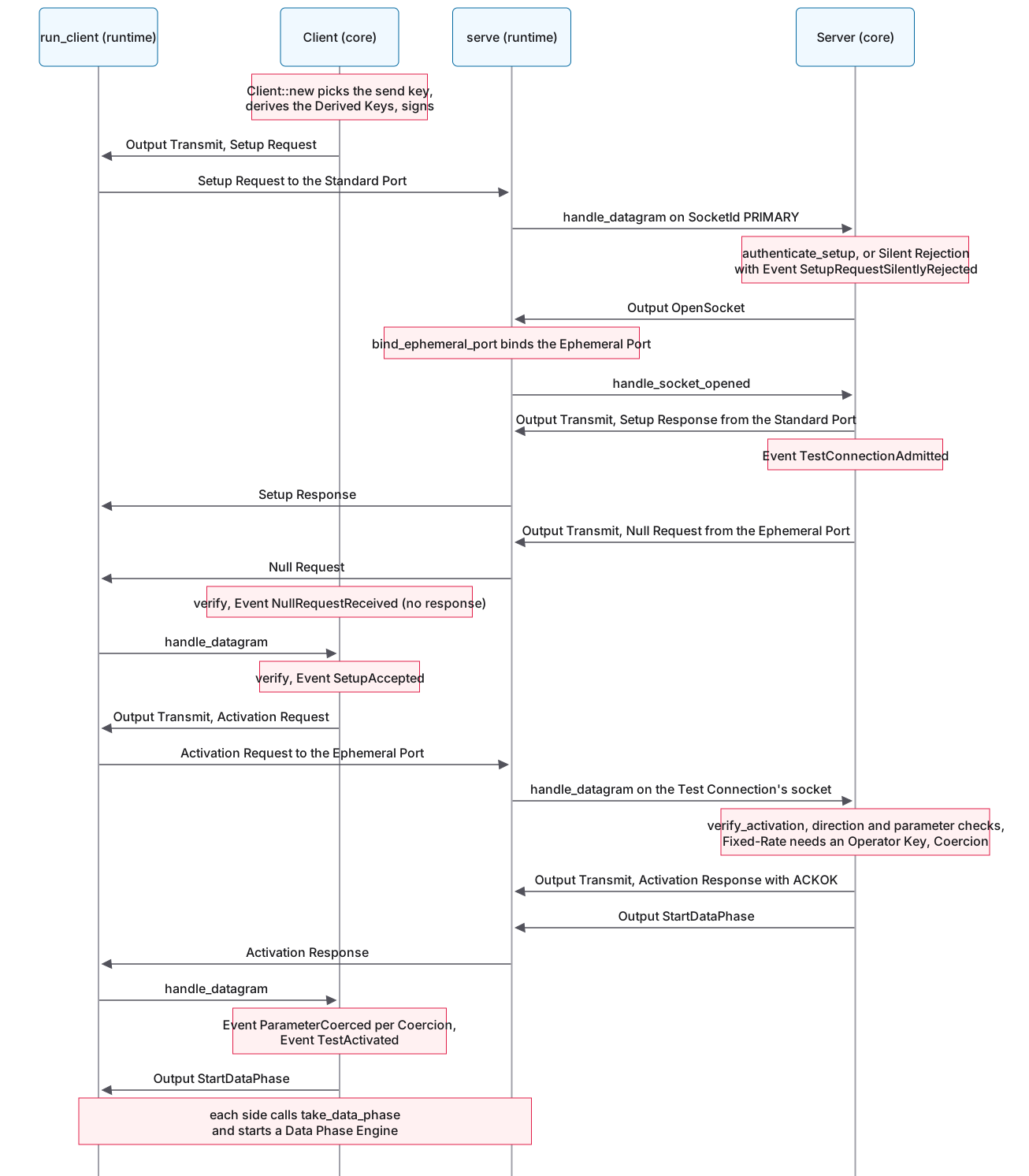
Step by step, with the code that handles it:
-
Setup Request.
Client::start(crates/udpstp-core/src/client.rs) picks the Key Table row valid for sending, derives the Derived Keys from the authUnixTime the request carries, and signs the request with the Client Authentication Key. Without a key file or--unauthenticatedit fails withControlPhaseFailure::NoAuthenticationConfigured. -
Verification and Admission.
Server::handle_setup_request(crates/udpstp-core/src/server.rs) checks a Setup Request in the order the Conformance Recordsetup-check-orderrecords. A request from or to a multicast or broadcast address is dropped silently, and one whose arrival address the runtime couldn’t tell is ignored, not refused (Event::SetupRequestIgnoredwithSetupIgnoreReason::ArrivalAddressUnknown, ADR 0007), since the reply must leave from it; the Client retries. Then the size, the checksum when checksum use is configured and the field is populated (RFC 9946 §5.6’s rule for every PDU,checksum_use::passes, with udpstp-wire’schecksum::control_validsaying whether the field matches; senders fill it last withchecksum::fill_control), then authMode, the keyId’s row and its accept lifetime, then the global budget for unverified Setup Requests (dropped silently beyond it), then the digest (with Derived Keys cached per row and authUnixTime,crates/udpstp-core/src/budget.rs), then the ±5 s window. Every failure is a Silent Rejection reported asEvent::SetupRequestSilentlyRejectedwith aSilentRejectionReason; withtroubleshootingon, authentication failures are answered too, unsigned (AUTHREQ, AUTHNC, AUTHINV, AUTHFAIL, AUTHTIME). An authentic request then passes the replay cache, which drops a replay silently, and spends its Source’s budget (source_setup_burst, 48, refilled atsource_setups_per_second, 5); beyond it, a signed CONNFAIL. Requests in Unauthenticated Mode, which have no HMAC, don’t spend it. Then the Key Table row’s budget (key_setup_burstandkey_setups_per_second, 1000 each), which Unauthenticated Mode’s requests spend as one row; beyond it, silence, so a key holder’s flood costs at most that many admissions. Then the options: an authentic request (or one allowed in Unauthenticated Mode) with another protocolVer, or modifierBitmap flags other than CHSR_JUMBO_STATUS alone, gets a coded rejection (BADVER with the expected version, BADJS, BADTMTU), after the replay cache so a replay stays silent. Last comes Admission (crates/udpstp-core/src/admission.rs), each of whose refusals is a Setup Response, signed in an authenticated mode:- A duplicate of an admitted Setup Request from the same address is ignored, not refused (
SetupIgnoreReason::DuplicateSetupRequest). - The Multi-Connection checks refuse with MCINVPAR an mcIdent of 0, an mcIndex not below mcCount or already in use in the Test, and a Test Connection that disagrees with the Test’s others on mcCount, authMode or (when authenticated) keyId; a Test is its Client IP address plus mcIdent, and never has to be complete.
- A new Test from a Source (an IPv4 address or IPv6 /64) that already runs as many as
tests_per_sourceallows (1 by default), then a new Test past its Source’s or Key Table row’s Quota of Tests or load bytes per Quota Period, when one is set, are refused with CONNFAIL. Only activated Tests count, so a spoofed Setup Request can’t hold a Source’s place or use its Quota; a Test’s first Activation Request checks both again, and refuses with BADPARAM a Test that Tests set up with it pushed past them. - A missing maxBandwidth when
require_max_bandwidthis on (NOMAXBW). - The per-Test cap (
test_connections_per_test, 24, counted over the Test’s whole life so one kept alive can’t start new measurements under it), then the places reserved by activated Tests against the global cap (max_test_connections, 256), both CONNFAIL. When the Test Connections held unactivated fill their separate share (max_unactivated_test_connections, half of the global cap but at least the per-Test cap by default; configurable above the global cap), a Setup that would otherwise be let in closes the oldest of the Key Table row holding the most of them, those of Unauthenticated Mode counting as one group, so a flooding key evicts its own (Event::UnactivatedTestConnectionEvicted). - The Admitted Rate Cap (
admitted_rate_cap), then one Test’s share of it (max_test_share), both CAPEXC. maxBandwidth counts per Test Connection with CHSR_USDIR_BIT masked, against each direction’s cap separately, but only for activated Tests: a Test reserves its whole rate, in each direction its Test Connections state, when its first Test Connection activates, so a Setup never activated holds none, and of Tests admitted together past the cap the first to activate runs whole while the other is refused whole with BADPARAM. From then on each of its admitted Test Connections holds its rate, one still waiting for its socket included.
On success it asks for a socket, and
handle_socket_openedsends the Setup Response with the Ephemeral Port as testPort and starts the Activation Watchdog. A Setup holds its place in the unactivated share (only activated Tests reserve global places and rate) from acceptance, before its socket opens, untilhandle_socket_closed; a socket that can’t be opened is refused with CONNFAIL.Admissionkeeps every admitted Test Connection with its Test, its Source and the Quotas, and checks a Test Connection’s first valid Activation Request in this order: the direction its maxBandwidth was admitted for, then for its Test’s first the Tests per Source, the global Test Connection cap, the Admitted Rate Cap and the Quotas, which it then takes, then the Test’s one direction. Its first activation reserves global places for every admitted sibling, including one still awaiting its socket; a Test that no longer fits remains refused with BADPARAM (ActivationRejection::TestConnections) until all its Test Connections close, so closing a refused sibling cannot let the rest start. The Server keeps authentication, the budgets, the PDUs, the Activation Watchdog and the events. - A duplicate of an admitted Setup Request from the same address is ignored, not refused (
-
Null Request. Right after the Setup Response,
handle_socket_openedsends a Null Request (crates/udpstp-wire/src/null.rs) from the Ephemeral Port, signed like the Setup Response in mode 1, so the Server’s firewall lets the Client in. The Client verifies it if it arrives (Event::NullRequestReceived, orNullRequestIgnored) and never answers; nothing depends on it. It leaves from the Ephemeral Port, which is bound to the address the Setup Request arrived on. -
Activation Request. The Client authorizes the Setup Response’s source against local Server selection before examining its contents: the selected Server endpoint, or in an authenticated mode an explicit per-Server alternate IP address, from the selected Standard Port and IPv6 scope.
Client::handle_setup_responsethen verifies the response with the Server Authentication Key and sends the Activation Request to the signed Ephemeral Port at that authorized address. Neither a verified digest nor a Null Request authorizes another IP address. A response that fails verification is ignored (Event::SetupResponseIgnored); if it came from the selected Server’s address and rejects this Test Connection’s request, its code is still reported (Event::UnverifiedSetupRejection) as a hint when the Test initiation timer expires. A verified rejection ends the attempt withControlPhaseFailure::SetupRejected(SetupRejectionCode), and an undefined code withUnknownSetupResponse. The runtime sends only destinations selected by the core. -
Activation Response.
Server::handle_activation_requestchecks authMode and keyId against the Setup’s, then the digest and time. It rejects with CHTA_CRSP_BADPARAM an unknown direction, a second direction within one Test, an algorithm other than B or C, a Fixed-Rate Test without an Operator Key, a second activated Test from the Source, and, when an Admitted Rate Cap is set, a direction other than the one the Setup’s maxBandwidth was admitted for, or a Test whose maxBandwidth no longer fits the cap because another Test admitted with it activated first. A rejection closes the Test Connection’s socket. On acceptance it picks the Sending Rate Table row, no higher than the row matching the Setup’s stated maxBandwidth (a higher requested or Fixed-Rate row is coerced to it), sends the Activation Response, and creates theDataPhase. -
Coercion. Both ends compute the differences between request and response with
coercions()(crates/udpstp-core/src/coercion.rs) and emit them as events. A Client configured to refuse a Coercion ends the Test with a STOP2 PDU.
Multi-Connection Coordinator. The Client runs every Test through Coordinator (crates/udpstp-core/src/coordinator.rs), the only Client-side endpoint the core exports: one Client, private to it, per Test Connection, spread round-robin across the Servers, each on its own socket. Every Setup Request goes out at once, and each Client holds its Activation Request. The Activation Requests go out together when every Setup has ended, or at the Setup deadline (1 s before the time limit, or half of it) once at least the Minimum Test Connections have succeeded; the rest are given up (Event::TestConnectionAbandoned). As soon as fewer than the minimum can succeed, the Test aborts (Event::TestAborted): before any Activation Request if it happens during the Setups. Each Data Phase starts when its own Activation Response accepts it. Each response’s parameters must match the first’s except for the Sending Rate Table row (TestParameters::same_test), or the Test aborts, and so does a Test Connection that refuses a Coercion. An abort stops the Data Phases that run, and answers an acceptance still on its way with a stop, so a Server stops its load within a round trip; one that arrives after the time limit goes unanswered, and the Server stops for want of Status PDUs. maxBandwidth is split equally, rounded down. The Load Receivers of a Downstream Multi-Connection Test keep their Status PDUs and Sub-Intervals to one grid, from when the Activation Requests went out plus the shortest Setup round trip (DataPhaseSetup::grid), so Sub-Intervals of the same number cover the same time and MeasurementResults::of_test sums them; one closed late by a stall, or that ran less than half its time, is no measurement. In an Upstream Test each Server keeps its own Sub-Intervals, so the sum by number is approximate, and the results say how far apart they were learned (MeasurementResults::approximate). The on-wire subIntSeqNo stays a per-Test-Connection count, so the Server’s log numbers Sub-Intervals its own way. Once running, a Test Connection fails when its Data Phase stops hearing its peer (DataEvent::TrafficStopped, which carries when the silence began), or ends any way but complete; the runtime and the simulator pass every Data Phase event on with Endpoint::handle_data_event. The Test goes on while at least the Minimum Test Connections haven’t failed, and otherwise stops the healthy ones; two or more falling silent within three Trial Intervals of each other are a path failure and stop the Test even when enough remain (TestAbort::TestConnectionsTimedOut). An abort mid-Test happens only while a healthy Test Connection is left to stop; those that fell silent are left to their Watchdog (ADR 0002).
A replay cache (crates/udpstp-core/src/replay.rs), shared by every socket, drops a verified mode 1 Setup or Activation Request seen again while it could still pass the time window (SilentRejectionReason::Replayed); Activation Requests are keyed on their sender too, since a Multi-Connection Test’s can be identical. Unauthenticated Mode bypasses it. In mode 2 every Status PDU is signed by its sender and verified by the Data Phase that receives it (StatusAuth in crates/udpstp-core/src/data_phase.rs).
ADRs: 0001 (KDF layout), 0009 (time window, signing, what the digest covers), 0010 (key selection, Operator Keys), 0007 (the arrival address).
5. Data Phase feedback loop
The Load Sender sends Load PDUs in Bursts from up to two Transmitters, as the Sending Rate Structure describes. The Load Receiver counts what arrives, including Sequence Errors, and sends a Status PDU every Trial Interval, starting one Trial Interval after the first Load PDU. The Server decides the rate in both directions.


What exists today (crates/udpstp-core/src/data_phase.rs):
- The row. The Server takes the row from the Activation Request: row 0 for CHTA_SRIDX_DEF, otherwise srIndexConf capped at the row the Client’s maxBandwidth allows, and, for a search without an Operator Key, at
max_start_row(Server::requested_row); a search then climbs from there up to the maxBandwidth row. The Sending Rate Table (sending_rate_table.rs) has OB-UDPST’s 1153 rows for the Server’s CHSR_JUMBO_STATUS and CHSR_TRADITIONAL_MTU settings, which a Setup Request must match: row N is N Mbps up to row 1000, 1250-byte packets or 1500 with Traditional MTU; above it OB-UDPST’s rates, Jumbo rows fitted to the Server MTU (server_mtu, 1500 by default) with more, smaller packets, each row never above its rate. The Server goes no higher than the first row at the table’s top rate, so a search can’t climb into repeated rows. At high rates the portable engine may fall behind well before the table’s top, sending a packet a call and receiving one a call on Windows and macOS; on Linux, which sends and reads in batches, a Load Sender’s thread topped out at about 4–5.6 Gbps over loopback in WSL2 (Skipped Bursts and loss report it; linux-batched-sending.md). The Load Rate Adjustment Algorithm moves the row after each Trial Interval, except in a Fixed-Rate Test. - Downstream. The Server is the Load Sender and sends from its row. The Client’s Status PDUs carry a zero Sending Rate Structure.
- Upstream. The Server is the Load Receiver, and each of its Status PDUs carries its row’s Sending Rate Structure. The Client applies it with
LoadSender::set_rateafter sanitising it to OB-UDPST’s field limits. - Catch-up by time budget. A missed Burst less than the catch-up budget late (1 ms, 2 ms on Windows, set by the runtime; ADR 0012) is still sent, oldest first, one Send Plan at a time; older ones are Skipped Bursts, reported as
DataEvent::BurstsSkipped. The most recent missed Burst always goes (ADR 0008, ADR 0012). - Over-rate policing. As the Load Receiver, the Server stops the Test Connection after 3 Trial Intervals in a row above 1.5 times the highest rate it assigned within the last second (
EndReason::OverRate; ADR 0011). - Stale Status PDUs. A Status PDU whose spduSeqNo isn’t greater than the last one processed only counts as heard: it can’t change the rate, deliver STOP or be echoed for RTT, and is reported as
DataEvent::StaleStatusPdus. Load PDUs carry spduSeqErr, the Status PDUs missing before the latest one, as OB-UDPST counts it. - IPv6. A Load Sender on IPv6 takes 20 bytes off every size in the Sending Rate Structure.
- Delay variation and RTT. The Load Receiver takes each in-order Load PDU’s receive time minus its lpduTime, in ms rounded as OB-UDPST rounds, and reports it less the running minimum (clockDeltaMin). The Load Sender echoes the latest spduTime with rttRespDelay; the Load Receiver turns that into rttMinimum and rttVarSample. Both run on the Test Time Base, so a wall-clock step or slew during a Test changes neither.
- Interval classification. The Server classifies each Trial Interval as a Clean, Errored or Hold Interval, from the Status PDU it receives (Downstream) or sends (Upstream), and reports it as
DataEvent::TrialIntervalClassified(crates/udpstp-core/src/interval.rs). DelayVar is the maximum one-way delay variation, the delay range the RFCs judge (the average if the Server’sdelay_var_statisticsetting says so, as OB-UDPST does), or the latest RTT sample when useOwDelVar is off. An interval with no delay sample is never clean. The Client classifies them too, the Status PDUs it sends (Downstream) or receives (Upstream), always by the maximum, only to count them (IntervalCounter, counters only): as its Data Phase ends,DataEvent::TrialIntervalsCountedsays how many were Clean, Errored and Hold Intervals, how many of the Hold Intervals had no delay sample, and whether slowAdjThresh Errored Intervals ever came back to back, confirming Congestion. It can’t see the Server’s Lost Status Backoffs, and an OB-UDPST Server classifies by the average by default, so the two counts can differ. - Algorithm B. Each classified Trial Interval moves the Server’s Sending Rate Table row (
crates/udpstp-core/src/algorithm.rs), and the row it chose rides on the classification event. In Fast Mode a Clean Interval adds highSpeedDelta rows, up to the 1 Gbps row. slowAdjThresh Errored Intervals back to back latch Congestion Confirmed and take 3 × highSpeedDelta rows off once (ADR 0005); every other change is one row. Downstream the Server sends at the new row at once; Upstream the row goes out in the Status PDU that reports the Trial Interval. A Fixed-Rate Test holds its row. - Algorithm C. In Fast Mode it doubles the row on every second Clean Interval (row 0 goes to row 1 first), jumping to the 1 Gbps row when doubling would pass it. Its single steps count toward RetryThresh (5 at first); at it, a Fast-Mode Retry clears Congestion Confirmed, and after a retry from a step up RetryThresh grows by 5. The Client asks for it with
--algorithm c. - Lost Status Backoff. In a Downstream Search Test, when no valid Status PDU has arrived for upperThresh + (2 + w) × trialInt since the last one (or since activation), the Server backs off as for an Errored Interval, which can confirm Congestion, and w counts up. w starts at the Setup Response’s round trip divided by trialInt, rounded up and capped below the 1 s Status PDU timeout, so a long path gets no backoff before its first Status PDU; any valid Status PDU, stale or not, starts it over (RFC 9097 §8.1, ADR 0005 as amended). A backoff is reported as
DataEvent::LostStatusBackoff. Upstream Tests rely on the 1 s timeout.
The core computes a Test’s measurement results from the Data Phase’s events (MeasurementResults in crates/udpstp-core/src/results.rs): one Test Connection’s, or a Multi-Connection Test’s summed, with each Sub-Interval, the IP-Layer Sender Bit Rate over it, measured by the Load Sender or else estimated by the Load Receiver, and each Capacity Mode’s Maximum and Highest IP-Layer Capacity, under the Client user’s Evaluation (Performance Criterion and Capacity Mode split). When the Client learned each Sub-Interval is a runtime fact, which the binary keeps. It also judges a Search Test’s searches (SearchTest in crates/udpstp-core/src/search.rs): whether one found the path’s limit, by its Client’s count of its Trial Intervals. Below the 1 Gbps row a search that rises past the limit confirms Congestion at its first overshoot. Above it the search steps a row at a time, and through a shallow queue its Errored Intervals can come one or two at a time, too few back to back to confirm Congestion: it met the limit when, of its last 64 Trial Intervals, from the first Errored Interval among them on, at least 4 and at least 1 in 4 were errored, Hold Intervals of both kinds counted among them, which the count keeps in a 64-bit register. When no Test Connection’s search found the limit either way, it says why each fell short, the first that fits: its IP-Layer Sender Bit Rate stopped at the maxBandwidth it stated, at the highest row at or below it, or reached the top of the Sending Rate Table, judged from the size of the Load PDUs sent at its peak, which the Server’s MTU decides; more than half its Trial Intervals were Hold Intervals with a delay sample; it was still rising at the end by more than Fast Mode adds with half its Trial Intervals clean; or else it stopped rising though few of its last Trial Intervals were errored, so the Load Sender may not have kept up. Its known limits are in the running-a-test guide: the Client’s count can differ from the Server’s (the Trial Intervals after STOP1, Status PDUs lost on the way back, the Server’s Lost Status Backoffs, algorithm C’s Fast-Mode Retries, and an OB-UDPST Server’s looser count and average delay variation), and a Load Sender held to a packet rate steps up as its Load PDUs grow past the 1 Gbps row, which a short Test reads as still rising. By the same 5% margin it judges whether a Downstream Fixed-Rate Test’s Server kept its rows’ sending rate where each Maximum IP-Layer Capacity was measured, as the Client estimated what it sent (FixedRateTest); the binary asks only once every activated Test Connection completed. The binary builds a Test’s results once, from the runtime’s TestOutcome and the options that shape them, in TestResults (crates/udpstp/src/test_results.rs): the whole Test’s results and each Test Connection’s, how each ended, the warnings, what is said as the Test ends, and the exit status. How one Test Connection ended is one module’s answer (TestConnectionEnd in crates/udpstp/src/test_connection_end.rs): from its outcome, its ErrorStatus and whether it completed, its names in the JSON results, how its Data Phase ended, and what is said of it, the same for a Test Connection of a Multi-Connection Test, named by its mcIndex, which says once what concerns the whole Test. Its exit status and its words both follow one private account of why it ended, each by an exhaustive match with no catch-all, so a new way to end can’t get one without the other; exit.rs only combines a Test’s statuses as OB-UDPST does. The text and JSON results (crates/udpstp/src/results.rs, json.rs) only render it.
ADRs: 0005 (Congestion Confirmed latch), 0002 (silence timeouts), 0004, 0008 (bounded catch-up, over-rate policing), 0011 (policing against the rates of the last second), 0012 (catch-up by time budget).
6. Data Phase Engine
Tokio’s timer is 1 ms-granular and was measured more than 1 ms late, so nothing precise runs on it (ADR 0003). The Control Phase hands each activated Test Connection to a Data Phase Engine, which sends its Send Plans at their scheduled times.


One thread per Test Connection: the per-Test-Connection executor. crates/udpstp-runtime/src/engine.rs runs one OS thread per Test Connection: the Client’s on every OS, and the Server’s on Windows and macOS (a Linux Server runs the pooled executor, below; ADR 0008). The Test Connection’s socket is cloned when it is bound (bind_shared). When the Data Phase starts, the Tokio reader task is aborted and the Engine Thread reads the clone, non-blocking, through the socket module (below). The Control Phase then lets go of its Tokio handle, so the socket leaves Tokio’s reactor, whose registration would otherwise wake the Control Phase’s thread for every datagram that arrives and every send the kernel completes; the Client keeps the socket open, out of the reactor and unread, until the Test ends, so the peer’s last datagrams draw no ICMP errors. The Test Connection’s protocol work is its slot’s (Slot in engine/slot.rs: its DataPhase, its socket, and a method for each step of a turn below), and the thread is the per-Test-Connection executor, which owns one slot, runs its turns and waits between them, so another executor can drive the same slots. The executor also says when the slot reads the clock (engine/times.rs): this one reads a fresh clock pair (three clock_gettime calls on Linux) for every core call, and before and after every read of the socket, as it always has; Turn, for an executor that serves many slots a turn, reads one pair as the turn starts, the Test Time Base alone (Clock::mono, one call) wherever the core judges or stamps time, with the wall clock carried on from the turn’s pair, and a pair after each read that returned datagrams, none around a read that returned nothing. Each turn (PerTestConnection::run):
- If the stop flag is set, call
DataPhase::stoponce. - Send every due Send Plan whole:
poll_burst,write_datagramsjust before the send, the datagrams (Socket::send_plan), thenreport_sentwith how many reached the kernel. A send the socket can’t take ends the Send Plan there, the rest becoming Deferred Datagrams. The turn sends for at most 1 ms (SLICE), and between the Send Plans of a catch-up it reads what arrived (ADR 0012). - Read what has arrived (
Socket::receive), so a Status PDU waiting in the socket counts before any timeout is judged. - Handle a due timeout, then send every due Status PDU (
poll_transmit,Socket::send). - Forward
DataEvents to the Control Phase. AfterDataEvent::Ended, exit. - Wait until the next deadline (
next_burst_atorpoll_timeout): the wait policy (wait.rs). On Linux the engine waits on its socket (Socket::ready,ppoll), at nanosecond resolution and at most 10 ms (IDLE_CAP), so an arrival ends the wait at once. After a turn that read datagrams, a Load Receiver leaves POLLIN out for a receive hold-off, a quarter of the time its receive buffer holds at the arrival rate, within 100–250 µs, so it reads what arrives meanwhile with one call rather than waking for each datagram. It holds off only when more than one datagram is due within the hold-off, at the rate datagrams arrived in its last window of at least 10 ms, since a hold-off that ends with nothing to read costs a wake-up of its own: at row 4, a Load PDU every 1 ms, it waits for each arrival and wakes once per Load PDU, where it woke twice. The rate is what arrives, not the row, which the Client doesn’t know in a Downstream Test; until a window with arrivals in it has closed, at the start and after a pause, a Load Receiver holds off as before. Rows that send a Burst of five to ten Load PDUs every 1 ms (41 to 99) still hold off, and wake twice a Burst as before where the Burst arrives back to back. Waking on each arrival leaves the wake-up to the receive softirq, which then more often wakes a CPU that halted: in a VM that costs it more per Load PDU (research/receive-hold-off.md has the measurements, and what decides whether the rule stays). A Load Sender takes each Status PDU at once, holding off only when datagrams arrive less than 1 ms apart, a flood. A pending error (POLLERR) is drained from the error queue in the wait, by the socket, whose wait won’t leave one pending (Socket::ready). A spin guard counts wake-ups that made no progress and, after 8 in a row, sleeps through the next 64 waits, at most 250 µs each. Elsewhere, and where the kernel refusesppoll(ENOSYS, EPERM, EINVAL), the engine sleeps, at most 1 ms (SLICE), so an arrival waits at most that long. Each Engine Thread on Linux runs with 1 ns timer slack (ADR 0008).
A Test Connection’s socket (crates/udpstp-runtime/src/socket/) is the per-socket I/O behind one interface, Socket: send a Send Plan’s datagrams, or one more datagram, and say how many reached the kernel; hand what arrived from the peer to a sink (Sink: Status PDUs, Load PDUs with the clock pair read around each read, and path errors); wait until ready, draining a pending error to the sink (Linux); and report the fast paths it used (FastPaths), its Receive Buffer Overflows and its send lag. Behind it:
- Sending goes with the fastest calls the kernel takes. On Linux in batches (
socket/batch.rs):sendmmsgcalls of up to 64 messages, each run of equal-sized Load PDUs one UDP GSO message, ending with a smaller Add-on where there is one. A GSO send the kernel or device refuses (EIO, EINVAL, EMSGSIZE, EOPNOTSUPP, ENOPROTOOPT) turns GSO off for the Test Connection, and a refusedsendmmsg(ENOSYS, EINVAL, EIO, EOPNOTSUPP) turns batching off; then, and elsewhere, one send per datagram. Before the engine starts, the socket is connected to the peer on Linux, on the Client too, so itssendmmsgcalls carry no address; the Server’s is already connected. - Reading is bounded per turn: up to 256 datagrams in batches on Linux (
READ_BUDGET), and elsewhere one at a time for at most 1 ms (READ_SLICE; a count of 256 left a Windows Load Receiver behind at 2.1 Gbps). On Linux they are read in batches (socket/batch_read.rs):recvmmsgcalls of up to 64 datagrams, a Load Receiver’s header-only withMSG_TRUNC, each with itsSO_TIMESTAMPNSreceive timestamp and TOS, and one clock pair read around each call. The socket asks for receive timestamps and the TOS (IP_RECVTOS,IPV6_RECVTCLASS) and turns off the arrival addresses the Client’s Control Phase asked for, so every datagram carries the same control messages, which nix’srecvmmsgneeds (the count of Receive Buffer Overflows, where the socket asks for it, arrives only from the first overflow on, so the first read after it loses its control messages, once as a rule, and the count is unknown until a datagram’s arrive whole again); a refusedrecvmmsg(ENOSYS, EPERM, EINVAL, EOPNOTSUPP) turns batched reading off, for onerecv_fromper datagram, timed by the read. Datagrams not from the peer are dropped; Status PDUs go to the sink one by one, and the Load PDUs between them together. - Transport errors (ADR 0006) are classified once, by one classifier per OS (
socket/classify.rs), given the call that failed (a send, asendmmsgwith or without GSO, a send whose messages carry the numbers of their kernel send timestamps, a read, arecvmmsg, appoll, a Control Phase send or read) and the error: make the call again; a full send buffer, so the rest waits; a path error of a kind to report, a send being made once more; a datagram too large for the Path MTU, which counts as sent and lost; a fast path the kernel refuses, which the socket stops using; or fatal, the only failure a caller sees. The same code can mean different things on different calls: EINVAL ends a plain send or read, but refuses the fast path on the batched calls andppoll, and on a send whose messages carry their numbers may be the kernel refusing the numbers; EMSGSIZE refuses GSO on a GSO send, and is a Path MTU event on any other. Every error number an OS returns that the runtime acts on is named there and nowhere else, each OS’s in a table test, and so is what an entry of Linux’s error queue means (socket/errqueue.rs). - Kernel send timestamps. With
UDPSTP_KERNEL_TX_TIMESTAMPS=1, an experimental setting, a Linux Load Sender asks for software send timestamps (SO_TIMESTAMPINGwithOPT_IDandOPT_TSONLY), drains them from the error queue with the ICMP errors, matches each to its Send Plan by the number it comes back with, and reports how much later than lpduTime the kernel sent it (socket/send_stamps.rs). Where the kernel takes it (Linux 6.13 and later, found by a probe once a process), each message carries its own number in anSCM_TS_OPT_IDcontrol message, so a send the kernel refuses shifts no later number, and a Test with refused sends keeps its send lag. The numbers start at 2^31, half the u32 range away from the kernel’s own, which start at 0: a kernel that ignored them would stamp the messages with numbers that match no Send Plan, giving no lags rather than wrong ones. nix’ssendmmsgshares one set of control messages across a call, so the Linux adapter then sends each message of a batch with asendmsgcall of its own (socket2’s) and reports how many the kernel took, assendmmsgwould; it offers batches that don’t go in onesendmmsgcall, so the socket reports UDP GSO withoutsendmmsgamong the fast paths. A numbered send the kernel refuses with EINVAL, as it refuses a number it doesn’t take (the classifier’s reading:socket/classify.rs), goes again without the numbers; if that goes, messages carry none from then on, batches go insendmmsgcalls again, which the socket then reports, and no more lags are counted, so the experimental measurement can’t fail the Test. Elsewhere the kernel numbers the messages, and it can number one it then refuses, so the count stops at the first send refused, whole or in part.UDPSTP_KERNEL_TX_TIMESTAMPS=kernel-countleaves the numbering to the kernel on every kernel (the socket’sSettings::explicit_numbersoff), so a result can be checked on that send path, with batches insendmmsgcalls. Matching each timestamp by the Load PDU the kernel can queue with it was measured and not chosen: over loopback each copy takes up to 46 KB of the receive buffer the Status PDUs share (research/send-stamps.md). - Adapters.
Portablesends and reads one datagram per call with std’s socket (Windows, macOS).Linuxadds the batched calls,ppoll, the error queue, send timestamps and Receive Buffer Overflows (socket/overflows.rs), and makes its single sends and reads withPortable’s calls. It counts the overflows from the process’s own UDP tables in/proc/self/netwhen the Data Phase ends, or, where it can’t read them (since Linux 7.2, a/procmounted withsubset=pidby a mounter withoutCAP_NET_ADMINover the network namespace hides them), from the count the kernel attaches to each datagram read in batches (SO_RXQ_OVFL), which misses the overflows after the last datagram read. AnOpenrecipe given to the engine at spawn (engine::spawn_with) opens the adapter on the Engine Thread, since nix’s header sets aren’tSend: the platform’s own (Platform), or, in tests, the fault adapter (socket/faults.rs), which wraps either and injects faults into its calls. Everything is dispatched statically. - Engine settings. The experimental variables that change how the engine runs (
UDPSTP_ENGINE_CATCH_UP_US,UDPSTP_ENGINE_HOLD_OFF_US,UDPSTP_KERNEL_TX_TIMESTAMPS, and a Linux Server’sUDPSTP_ENGINE_THREADSandUDPSTP_ENGINE_GROUPING_US) are read by the binary once, instart::engine_settings(crates/udpstp/src/start/mod.rs), and passed as one value,EngineSettings, inServerOptionsand torun_test, which give it to each engine at spawn. The runtime reads none of them; only the test-onlyUDPSTP_FAULTS, which belongs to itsfault-injectionfeature.
The turn loop and the wait policy stay outside the socket module, so the pooled executor (below) drives the same sockets with a loop and a wait of its own. When the engine exits, however it ends, FromEngine::Exited carries its account of how the Data Phase ran on this host as one value, EngineFacts (crates/udpstp-runtime/src/engine.rs): the socket buffers it got as it started, the fast paths it used, its socket’s Receive Buffer Overflows and, when asked for, the kernel’s send lag. The Control Phase passes it on unread, in ClientOutcome::engine_facts and the Server’s ServerNotice::DataPhaseEnded, so a fact the engine adds reaches the Client’s results and the Server’s log without touching the loops; the binary’s renderers read the facts they show, and the Client’s results combine a Multi-Connection Test’s in one place (crates/udpstp/src/test_results.rs).
A panic on the engine’s thread, as its socket opens or in the turn loop, is caught (catch_unwind). It ends only that Test Connection, and the engine always reports FromEngine::Exited. The Control Phase then closes the socket and calls handle_socket_closed, which releases Admission (ADR 0003); tests that inject the panic, mid-Test and as the socket opens, prove it (the fault adapter). The engine reports through an unbounded channel, so a busy Control Phase never blocks it. Dropping or stopping the Engine handle sets the stop flag.
The Linux Server: the pooled executor. A Linux Server runs its Test Connections’ slots on Engine Threads (engine/pool.rs, engine/pool/thread.rs), its only executor; the Client and every endpoint on Windows and macOS keep a thread per Test Connection (ADR 0008). The pool starts at most as many Engine Threads as the CPUs the process may use (available_parallelism: its affinity mask within a cgroup quota; UDPSTP_ENGINE_THREADS overrides it), lazily, unpinned, each named udpstp-eng-<index>, and places a new Test Connection on the one serving the fewest, never moving it (engine/schedule.rs, place). The Server logs how its engines run once at start (DataPhaseEngines). EnginePool::start makes the socket ready on the Control Phase’s thread and sends the Test Connection to its Engine Thread over a channel, writing its eventfd; stops go the same way, so a waiting Engine Thread sees one at once. Each Engine Thread’s turn: one clock pair (Turn); the commands; readiness harvested from its edge-triggered epoll set with a zero timeout onto a ready list (a socket with an error pending marked so, drained before it is read); every due Burst, earliest deadline first from a deadline heap, for at most 1 ms in all, the rest in a turn that follows at once; each slot on the ready list read up to its 256-datagram budget, one whose budget ran out going to the back for the next turn; the due timeouts and Status PDUs of the slots it touched, a Load Receiver whose timeout is due read first; their events; then the heap re-keyed. It waits in ppoll on its epoll fd and eventfd until the earliest deadline, at nanosecond resolution, or with none until an arrival or a command. receive hold-off is the Engine Thread’s: after a turn that harvested and read, when more than one datagram is due within it at the rate all its sockets received at, the epoll fd is left out of the wait until a fixed end, at most 250 µs and at most the shortest share of a reading slot’s receive buffer less its longest recent turn, none under 100 µs. A known gap: the buffer share counts the payload bytes read, not the memory the kernel charges for them, so on loopback and veth, which charge a datagram split from a UDP GSO message far more than its size, a fast Load Receiver sharing an Engine Thread with Load Senders can overflow its receive buffer; over a NIC the share holds. A later fix would judge the share by the socket’s receive memory (engine/schedule.rs, HoldOff, has the details). With a grouping window (UDPSTP_ENGINE_GROUPING_US, an experimental setting, 0 by default, since no measurement has yet shown a window worth making the default: ADR 0008), a wait ends at the last deadline within the window of the earliest, never past a hold-off’s end. The spin guard and the sleeping fallback where the kernel refuses ppoll are the Engine Thread’s. Each slot’s work runs in a catch_unwind of its own, so a panic retires that Test Connection alone, out of the epoll set before its socket closes; every handover carries an exit reporter whose Drop reports its end unless it was reported, so a panic in the Engine Thread’s own loop, or a handover queued to one that died, still reports every end and so releases every Admission; a handover to a dead Engine Thread goes to another. Where the Receive Buffer Overflows are read from the process’s UDP tables, an ending Test Connection’s socket goes to one thread of the pool’s, which reads the tables once for each batch of ends and reports each end, so an Engine Thread never parses /proc. Its sockets report the fast path epoll, not ppoll. Its policy is pure and tested alone (schedule.rs); on loopback it meets the plan-executor contract with 1 and with 32 Test Connections on one Engine Thread (engine/pool_tests.rs), and a test run in a process of its own checks that 8 Tests on one Engine Thread allocate nothing in a second of their steady state (ADR 0008), with a counting global allocator in the test build (stats_alloc).
7. Test Connection lifecycle
In the Control Phase, the Client holds its state in the State enum (crates/udpstp-core/src/client.rs). The Server tracks a Test Connection in its Admission (crates/udpstp-core/src/admission.rs): admitted, it waits for its socket; once the socket is bound it is set up, and later activated, the Server’s own data about it (its Setup Request, its authentication, its Activation Watchdog) kept alongside. In the Data Phase, both ends move through the Phase enum in crates/udpstp-core/src/data_phase.rs, each knowing whether it is the Test Connection’s Client or its Server (End): in the STOP exchange the Server stops and the Client confirms.


- Ends of the Data Phase.
DataEvent::Endedcarries anEndReason:Completed,Unconfirmed,TestIntervalElapsed,StoppedByClient,Stopped,WatchdogorOverRate.EndReason::completessays which of them complete the Test Connection:Completed, andTestIntervalElapsed, which OB-UDPST counts as complete too; the Multi-Connection Coordinator and the Client’s exit status and results all ask it. After 1 s without valid PDUs the endpoint stops sending (DataEvent::TrafficStopped), and the Watchdog ends the Test Connection 3 s after the last PDU. The Client’s Test Interval timer runs to the Test Interval plus 1.5 s, which leaves room for the Server’s STOP2 to arrive. - Released. On the Server,
handle_socket_closedremoves the Test Connection, releases its Admission and emitsEvent::TestConnectionReleased. The Server’s runtime calls it when the engine exits, however it exits, after passing on the engine’s last Data Event, so what ended the Data Phase is reported before the release; when it closes a socket the core asked it to (a BADPARAM rejection, an Activation Watchdog, an eviction, a shutdown); when no Ephemeral Port could be bound; when a Test Connection’s socket reader fails before its Data Phase; and when the core asks it to stop a Data Phase that isn’t running. The simulator does the same. The Client’s runtime reports every engine exit the same way, and the Multi-Connection Coordinator counts one that exited withoutDataEvent::Endedas a failed Test Connection. On the Client,run_testreturns once every Test Connection’s engine has exited and the Multi-Connection Coordinator has no deadline left. The Client ends in itsState::Endedon a rejection or a Control Phase failure. When the Server administrator stops the Server,Server::handle_shutdownstops each Test Connection in its Data Phase (Output::StopDataPhase) and closes any other, and each is released as it goes. - A Test Connection abandoned before activation is closed by its Activation Watchdog 3 s after the Setup Response, which releases its socket and Admission.
ADRs: 0002 (traffic stops at 1 s, the Watchdog ends the Test Connection at 3 s), 0003 (Admission released on every exit path), 0008 (over-rate stop).
Where to start reading the code
crates/udpstp-core/src/lib.rs: theEndpointtrait and the public API.crates/udpstp-core/src/io.rs,time.rs,event.rs: what crosses the boundary.crates/udpstp-core/src/server.rsandclient.rs: the Setup and Activation exchanges.crates/udpstp-core/src/data_phase.rs:DataPhase,SendPlan,LoadSender,LoadReceiverand the STOP exchange.crates/udpstp-runtime/src/server.rsandclient.rs: the Tokio Control Phase loops.crates/udpstp-runtime/src/engine.rs: the portable Data Phase Engine;socket/mod.rs: a Test Connection’s socket, which it drives.crates/udpstp-wire/src/lib.rs, thensetup.rs,activation.rs,load.rs,status.rs,auth.rs: PDU codecs and authentication.crates/udpstp/src/main.rs,config.rs,start/,keyfile.rs,service.rs: the binary, configuration, what each role starts with, key files, and the Server as a Windows service (ADR 0014).crates/udpstp-core/tests/harness/: the deterministic simulator the protocol tests run on.crates/udpstp/tests/loopback.rs: end-to-end Tests of the real binary over loopback.